Before you pull in
- Check you're allowed to use it. Many dump stations are for registered campers only. Of the 4,745 stations on 48state, 844 are listed as open to the public and 428 as campers only; for the rest the source doesn't say. Each listing has an Access line.
- Check it's open. Park and rest area stations often close for winter or when water lines are shut off. Every listing shows the date we last checked it.
- Know the fee. Of the 101 listings on 48state whose source states a per-use dump fee, the most common prices are $5 (54 stations) and $10 (22), and the median is $5. At Nevada state parks, the dump fee is the park's entrance fee even if you aren't camping (Nevada State Parks). 193 stations on the site are listed as free: see free RV dump stations.
How to dump your tanks, step by step
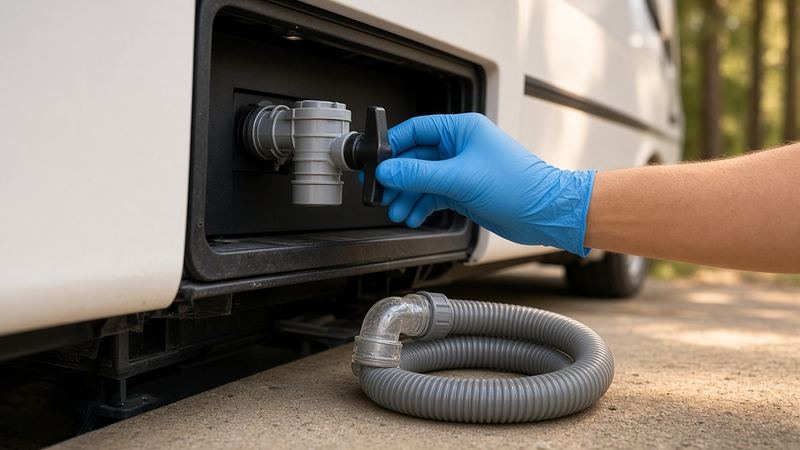
- Put on disposable gloves and keep them on until the hose is stowed. Winnebago recommends gloves and sanitizing the handles afterwards.
- Connect the sewer hose to the RV outlet, then put the other end well into the station inlet and secure it so the surge doesn't pop it out; that's what the rock at many stations is for (Winnebago).
- Open the black tank valve first. When it has drained, close it.
- Then open the gray tank valve. Gray water last helps rinse black-tank residue out of the hose (Winnebago).
- Rinse with the station's non-potable hose, never your drinking-water hose: "Never use your fresh water hose for rinsing sewer hoses or the dump station area" (Virginia State Parks).
- Disconnect, cap and stow. Rinse any spill into the inlet, then wash your hands.
- Fill fresh water only from a potable spigot, if the station has one.
Dump station etiquette and rules
- Wastewater goes only into the station. "Trailers and RVs must empty sewage and wastewater at dump stations" (NPS, Shenandoah). Wastewater containers must be "emptied only at the dump station" (NPS, Sleeping Bear Dunes).
- It isn't a wash bay. "Washing vehicles at the dump station is prohibited" (NPS, Sleeping Bear Dunes).
- Skip tank flushing when there's a line. "If others are waiting to use the dump station, skip the tank flushing and hose rinsing steps" (Virginia State Parks).
- Only tank contents go in, and leave the station cleaner than you found it (Virginia State Parks).
Gear checklist
- A sewer hose that doesn't leak (Virginia State Parks suggests a heavy-duty hose about 6 to 8 feet long), a cap and an elbow fitting.
- Disposable gloves and a bag for them.
- A separate, clearly marked rinse hose, stored away from your fresh-water hose.
Where to find a dump station
Browse dump stations by state, open the national map and use Near me, or check rest areas and truck stops on your route. Every listing links to the official page it came from.